
Subscribe to our newsletter
for the latest edTech news, free resources and competitions!
Remembrance Day
Nov. 4, 2025
Remembrance Day or Armistice Day is held on the 11th of November and marks the day that World War I ended at 11 am on the 11th day, of the 11th month in 1918.
Facts about World War I
World War I lasted from July 28, 1914 to November 11, 1918.
The 'Allied Powers' (which included Russia, France, and the British Empire) fought against the 'Central Powers' (including Germany, Austria-Hungary and the Ottoman Empire). Fighting mainly took place in Europe, and around 15-22 million people died, making it one of the deadliest wars in history.
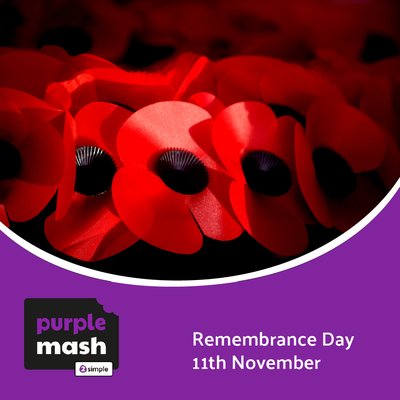
What is Remembrance Day?
While Remembrance Day marks the day that World War I ended, the day remembers the courage and bravery of those who fought and died in all wars, including WWI, WWII, The Falklands, and The Gulf War, as well as the conflicts in Afghanistan and Iraq.
As a mark of respect, in the weeks leading up to Remembrance Day, people wear a red poppy. Money raised from the sale of these goes to the Royal British Legion who use the money to support members of the Armed Forces and their families.

Remembrance is a prescient time for bringing people of all ages and backgrounds together to reflect upon the service and sacrifice of the Armed Forces, and to join together in the hope for a brighter, peaceful future.
Royal British Legion
On Remembrance Sunday and Remembrance Day, two-minute silences are held around the country at 11am. They take place in schools, places of prayer, and war memorials. These ceremonies usually include a piece of music called The Last Post being played on the bugle, followed by the two-minute silence. Wreaths of poppies are also laid.
King George V held the first two-minute silence on 11th November 1919 and made the request for the silence to be observed so that: “thoughts of everyone may be concentrated on reverent remembrance of the glorious dead”.
There are some poems associated with Remembrance Day, one of the most famous being In Flanders Fields, written by military doctor, Major John McCrae in 1915 during the war:
In Flanders fields the poppies blow
Between the crosses, row on row,
That mark our place; and in the sky
The larks, still bravely singing, fly
Scarce heard amid the guns below.We are the Dead. Short days ago
We lived, felt dawn, saw sunset glow,
Loved and were loved, and now we lie,
In Flanders fields.Take up our quarrel with the foe:
To you from failing hands we throw
The torch; be yours to hold it high.
If ye break faith with us who die
We shall not sleep, though poppies grow
In Flanders fields.
Royal British Legion Resources
The Royal British Legion also offer a wide range of free resources to support the teaching of Remembrance by schools and families, covering all the Key Stages. The resources are linked to the National Curriculum and include lesson plans, bite-sized activities and assemblies. Explore their resources here.
Purple Mash resources
We have put together a folder of classroom resources within Purple Mash that primary schools can use in the run up to Remembrance Day. These include a range of writing and paint projects.
Writing Projects
Children could either write an information text, or design a poster to explain what happens on Remembrance Day. Many veterans and heroes wear their medals on Remembrance Day, while family members can also wear their relative’s medals to remember acts of bravery. Children could design a medal for Remembrance Day as well as talking to family members about Remembrance and documenting their own stories.
Writing a letter to a person remembered on the day would help children describe their thoughts about the sacrifices made. Remembrance Day is of course a global event and is marked in different ways across the world. Using this exercise, children can write about how other countries commemorate those who have died in conflict.
Paint Projects
Using our paint projects children could draw a Poppy symbol for Remembrance Day and use our Poppy pattern tool from 2Paint a Picture to design a field of poppies pattern.





All of these activities are available to Purple Mash subscribers. If you don’t have a licence, you can experience everything that Purple Mash has to offer with a 14-day free trial. Register your free trial here.

‘They shall grow not old, as we that are left grow old: Age shall not weary them, nor the years condemn. At the going down of the sun and in the morning, we will remember them.’
For the Fallen
Laurence Binyon