
Subscribe to our newsletter
for the latest edTech news, free resources and competitions!
EU Code Week with Purple Mash
Sept. 30, 2026
EU Code Week is an initiative aimed at bringing coding and digital literacy to all, fostering creativity, and making technology accessible to everyone. The EU Code Week website has a range of resources and toolkits for teachers to help you get started.
If you are joining in with #EUCodeWeek, read on to see how you can support coding in school with Purple Mash - whether you’re a beginner or experienced coder, Purple Mash offers a suite of tools and resources perfect for this exciting week, as well as a FREE Code with Confidence teaching pack.
What is EU Code Week?
EU Code Week (October 11-26, 2025) is a grassroots movement supported by the European Commission. Its mission is to promote coding and computational thinking to learners of all ages. Schools across Europe and beyond can participate by hosting coding events, workshops, or lessons.
Why Participate in EU Code Week?
Coding isn’t just about writing lines of code—it teaches problem-solving, logic, and creativity. Participating in EU Code Week can help students develop these essential skills while joining up with local groups or schools in a safe, fun and meaningful way.
Purple Mash Coding Resources for EU Code Week
Purple Mash offers a range of coding tools, resources and challenges for teachers and students, making it ideal for #EUCodeWeek activities.
2Code
This is a versatile and easy-to-use tool that introduce block-based coding. With over 40 fun coding exercises like Fun with Fish, Splatty Bug, Feed the Duck, as well as quizzes and more, students can practice sequencing, repetition and selection in coding.
2Go
2Go is a simple and accessible tool for younger students to develop basic directional programming skills. It's perfect for moving on from floor robots and applying previous learning, while still keeping it visual and engaging.
Logo
Logo allows children to move on from 2Go and learn the Logo text-based coding language, program a 'turtle' to solve problems, create shapes and patterns, explore maths concepts and test algorithms.
2Chart
With 2Chart, children can create flowcharts that represent the logic behind their code, helping them understand the sequencing and decision-making processes essential in coding.


Mai-Z MouseBot
Mai-Z the MouseBot helps pupils connect coding with real-world outcomes through hands-on, engaging learning experiences, and comes complete with units of work, lesson plans and slideshows.
Purple Chip
Using the Purple Chip app in conjunction with our 2Code Purple Chip tool on Purple Mash allows students to control an external device (a phone or tablet) from code that has been written in and run from within Purple Mash.
micro:bit
There are now micro:bit lessons within Purple Mash for Years 3, 4 and 5. The lessons can be adapted for different age groups and include fun activities such as creating a name badge, step counter or a rock, paper, scissors game.


These tools can be used on their own, or teachers can use the detailed coding plans contained within the Purple Mash Computing Scheme of Work. There is a medium-term plan for each unit accompanied by detailed individual plans that walk the teacher through the lesson.
Watch a Recorded Coding Live Lesson
Got Purple Mash but aren't sure where to start with teaching coding? Use one of our recorded Live Lessons to help teach your next coding lesson:
Free Code with Confidence Pack
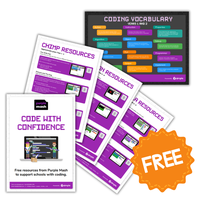
Get a taster of coding using Purple Mash with the free Code with Confidence Pack. Inside the free coding pack are coding games and challenges which children can complete, all with teacher solutions.
Transitioning to Python in Pieces
Python in Pieces would be a perfect resource to use for #EUCodeWeek. Transition your students from block-based coding to Python with guided lessons, open-ended activities and the ability to translate block-code to Python in both directions. Designed by teachers to empower the specialist and non-specialist to teach KS3 coding with confidence, Python is also perfect for developing the coding capability of your Year 6 students. The guided lessons allow students to manage their own learning and teacher solution guides enable teachers to support student learning at every step.
Better yet, Python in Pieces is now included in a Purple Mash subscription, so you can easily extend children in Computing.
