
Subscribe to our newsletter
for the latest edTech news, free resources and competitions!
Teacher's Guide to the Curriculum Review and DfE Response
Nov. 20, 2025
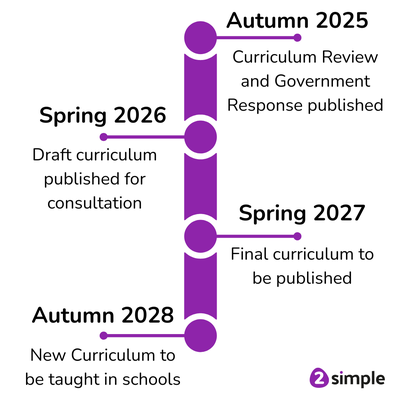
The long-awaited Curriculum Review has now been published, along with the Government’s official response. While these are still recommendations, they set the direction for what schools can expect from the next National Curriculum - to be finalised in 2027 and taught from 2028. In this guide, we break down the key points, what’s changing across subjects, and what it means for teachers right now.
The Big Picture: What's Changing and When
The Curriculum Review has set out recommendations for the new National Curriculum for 2028. It outlines a vision for a clearer, more connected digital curriculum with greater focus on oracy, literacy, numeracy and inclusivity. Other subjects will be updated and streamlined, with more focus on digital skills and sustainability.
The Department for Education (DfE) will now develop the new curriculum "with teachers, curriculum experts, pupils and parents" with the aim of publishing it in Spring 2027, with schools expected to teach it from September 2028.
Key Themes in the Curriculum Review
The DfE is focusing on three Key Themes for the new curriculum, and aims to modernise what's being taught to ensure children "have the right skills and knowledge to thrive in a changing world."
Building strong foundations
- More focus on oracy, reading, writing and maths from EYFS and through Primary
- A clearer, and better-structured curriculum in a logical order
- Inclusive support for all abilities
High standards, more choice
- Arts subjects to be revitalised
- Importance of two hours of PE to be reinforced
- Clearer language expectations in Primary schools
- Improvements to GCSEs and new vocational qualifications
Learning for a changing world
- Increased focus on financial education, media and digital literacy
- Improved climate and sustainability education
- Citizenship to be compulsory in Years 1-6
- Access to enriching activities such as arts, sports, nature, civic engagement and volunteering
- Better computer education within GCSEs and above
Subject-by-Subject Summary
English
The main focus within English is on creating an Oracy framework to support pupils to become "confident, fluent speakers and listeners by the end of Key Stage 2", and a refresh of the grammar content. This includes a review of the sequencing of the content as well as the statutory tests. Some more complex content may be moved into Key Stage 3.
It was also suggested that drama be added to the Primary English Programmes of Study to help the transition into Key Stage 3.
Maths
Content is potentially going to be resequenced to deepen pupils's understanding, particularly in Number.
The Multiplication Tables Check will remain, but refinements to access arrangements will be explored to support pupils who find it difficult in its current format.






Science
The science curriculum for Primary schools will be more consistent and cohesion, with clearer guidance on what should be taught when, and to what depth.
There will also be a more explicit teaching of the greenhouse effect, carbon emissions, burning of fossil fuels and deforestation as contributing factors towards rising sea levels and extreme weather.
Computing
There will be more focus from a young age on how computers can be trained using data, alongside AI literacy. More children will be encouraged to consider computing qualifications.
The government have also stated that they will continue to invest in the National Centre for Computing Education (NCCE).






PE
The government will revisit the aims of compulsory PE across all key stages with specific elements such as swimming, dance, and outdoor and adventurous activity considered as to how they are presented to support quality teaching.
Further detail will be added to the content on dance within PE.
RE
The review recommended that RE is moved into the National Curriculum, but recognises that this will not be immediate and should be completed with an independent group - made up of representatives from faith bodies, secular groups and experts from within education - set up to develop a draft RE curriculum first.





History
Statutory and non-statutory content will be clarified further to allow more freedom and flexibility for schools when deciding which periods of history to teach.
Updates will be made to terminology to improve understanding of disciplinary knowledge and skills. This includes understanding how historians study the past and how they construct historical claims, arguments and accounts.
The curriculum review will also aim to support teaching of diversity throughout history, including local history where appropriate.
Geography
It was agreed that Geography does not need a significant change, and most of the changes will be modest, and will apply mainly to the GCSE content.
Climate change and sustainability teaching may be updated and refined (although this again may relate more to GCSE).






Art
There will be further clarity added to the programmes of study in order to help non-specialist teachers.
The government will also support teaching a broader range of media, including digital media.
Design & Technology
The curriculum for D&T will be revised, with sustainability introduced, and 'Food and Nutrition' distinguished as a separate element - most likely for KS3 and beyond. It was noted that 'primary D&T is broadly working well and that content is relevant and 'deliverable with guidance' by non-specialist teachers.'






Music
The programme of study will be clarified to ensure that students will have a strong foundation in three pillars of musical understanding:
- Technical
- Constructive
- Expressive
This includes how to read music.
There will be continued investment in music hubs and a new National Centre for Arts and Music Education which will support schools in delivering high-quality teaching, as well as with access to instruments.
Languages
The government is going to work with experts to strengthen the primary languages curriculum, with pupil progress expectations made clearer, and core content for French, German and Spanish more clearly defined.
There will be continued investment in the National Consortium for Languages Education which supports teacher training and has an online platform for professional development.





Citizenship
Citizenship will be a new statutory requirement for key stages 1 and 2 at the earliest opportunity. It will include 'vital threads' of:
- Government
- Law and Democracy
- Climate Education
- Financial and Media Literacy